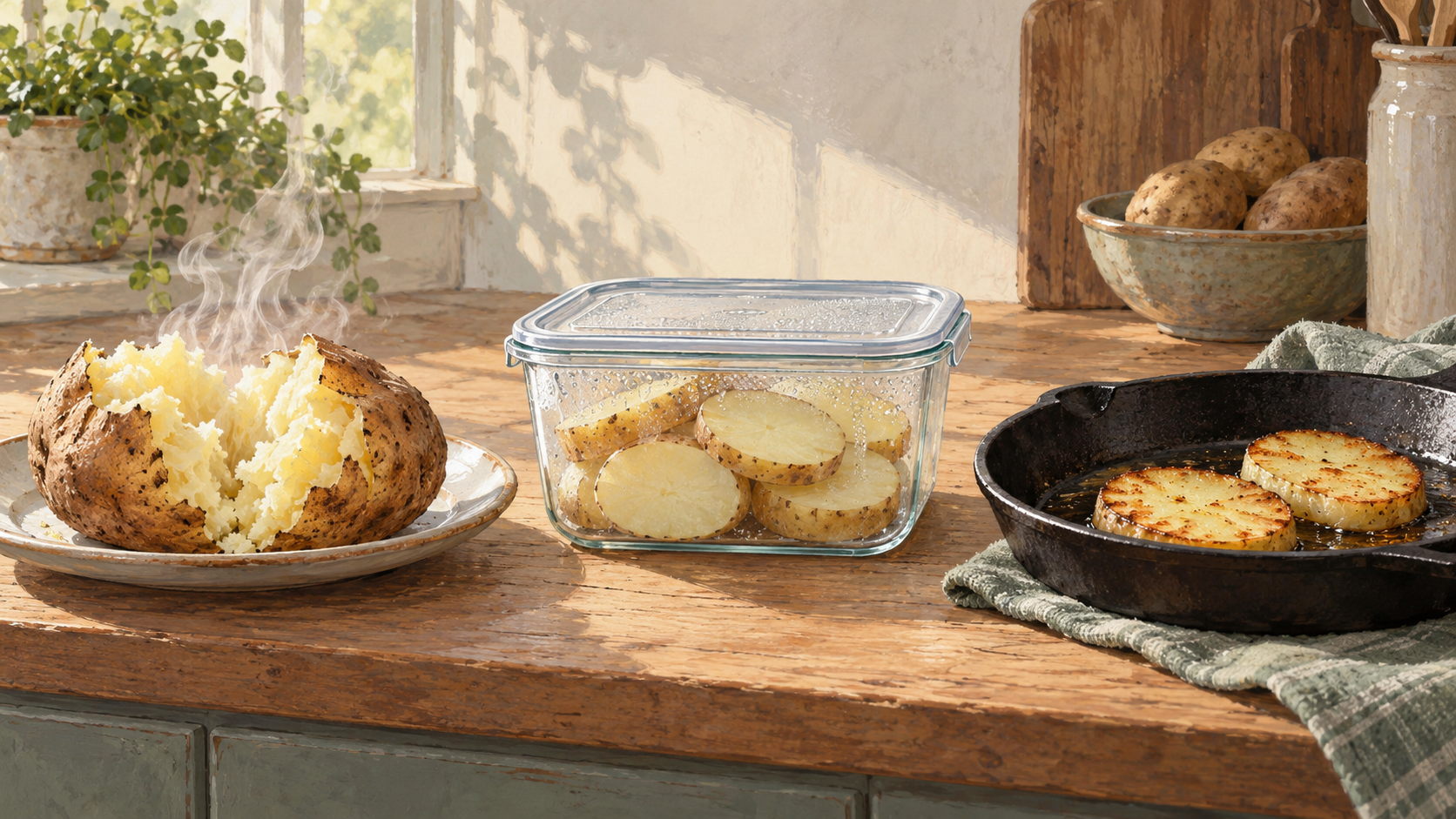
A potato lifted from boiling water yields easily to a fork. The same potato, cold the next day, often cuts into tidier pieces. Its starch has not returned to the neat granules it held when raw. After cooking loosened those granules, cooling gave some of their molecules a chance to gather into new arrangements. That quiet rebuilding helps explain why a leftover potato feels different, and why the choice between eating it cold and warming it again matters.
The change begins before the potato reaches the refrigerator. Starch fills many of its cells as granules made largely of two kinds of glucose chain: amylose, which is comparatively straight, and the much more branched amylopectin. Given heat and enough water, granules swell and lose much of their original order. Food scientists call this gelatinization. The starch becomes easier for digestive enzymes to reach, while the cooked tuber softens through changes in its cells and the material between them. The amount of water, the cooking method and how far the potato is cooked all matter. In experiments on Shepody potatoes, a short microwave treatment left more ordered starch than longer, wetter cooking; the authors interpreted this as incomplete gelatinization, not as proof that microwaving always produces a particular nutritional result. Dupuis and colleagues’ original study
The cold potato sets again
Cooling does not put the granules back together. Some of the loosened starch chains move close enough to associate with one another in new ordered regions. This is retrogradation: a second arrangement, made after heat has disrupted the first. Amylose can participate relatively soon; the branched amylopectin develops order over a longer period. The result depends on the temperature, time, water and other parts of the potato tissue. In the same Shepody study, longer refrigerated storage generally increased a measured signal of starch order, especially after the longer boiling treatments. The laboratory samples were held for up to seven days to study the process; that is an experimental time course, not a kitchen storage recommendation. Dupuis and colleagues’ original study
The fork notices a consequence that a molecular diagram cannot show. Tomasz Jankowski tested the texture of whole cooked potato tubers conditioned at 4°C and 20°C. Conditioning made the tubers harder and more cohesive, while reducing how adhesive and easily fractured they were, particularly at the lower temperature. The measured changes were linked to soluble starch and a network developing within the cooked potato. A cold cooked potato can therefore keep a cleaner edge when sliced or diced. The exact feel of a plate of leftovers still depends on the potato and how it was first cooked; one firmness measurement cannot dictate every salad or skillet result. Jankowski’s original texture study
Water belongs in this account too. A covered potato may firm up in the refrigerator even when it has not visibly dried out. Yu-Fan Nicole Chen studied cooked whole tubers using measurements that distinguish water moving in different parts of the tissue. In those experiments, refrigerated storage changed both starch order and water mobility; reheating restored some mobility and some susceptibility to enzyme breakdown. The point is that the interior changes as a system. Moisture loss at an exposed cut face can certainly affect eating quality, but “the fridge dried it out” is an incomplete explanation for a chilled, covered potato’s new texture. Chen’s original potato-tuber research
That difference makes leftovers useful in a different way from newly cooked potatoes. A hot, tender potato gives easily when crushed for mash. A cooled one may hold its shape better when cut for a salad or moved into a pan. This is a kitchen inference from the measured firming, not a guarantee for every cultivar. It also explains why adding water and warmth to a cold potato can bring back some softness without truly resetting it to the state it had at the end of its first cooking.
The resistant-starch claim has a size
Some retrograded starch resists digestion in the small intestine and is counted as resistant starch. A potato does not become mostly resistant starch merely because it spent the night cold. The useful question is how much changed under a stated method of cooking and serving. Susan Raatz and colleagues baked or boiled three commercial potato varieties, then measured resistant starch when the potatoes were served hot, chilled, or reheated after chilling. Averaged across their treatments, the assay found about 3.0 grams per 100 grams in hot potatoes, 4.3 in chilled potatoes and 3.4 in reheated potatoes. Baking also gave a higher measured amount than boiling in this experiment. The researchers found no statistically significant variety difference among the three they tested; that result does not settle the question for every potato grown elsewhere. Raatz and colleagues’ original paper
Those measurements illuminate a real change, but they do not translate directly into a promise about calories, blood sugar or long-term health from a particular dinner. Even short clinical studies ask narrower questions. In one trial of 13 healthy volunteers, a day of cold storage raised the resistant-starch fraction of boiled potatoes; the most pronounced reduction in the reported glucose and insulin indices came from a cold potato meal with vinegar dressing. Vinegar was part of that comparison. Cold storage alone lowered the insulin index in the trial, while the full set of results cannot be reduced to “every cold potato lowers blood sugar.” Leeman and colleagues’ original trial
Another crossover trial compared boiled potatoes with baked-then-chilled potatoes in 30 women with elevated fasting glucose and insulin. After the chilled meal, glucose and insulin were lower at some early measurements, and insulin exposure across two hours was lower; total glucose exposure over that period did not differ significantly. Because both cooking method and serving temperature changed between meals, the result cannot isolate chilling as the sole cause. These studies are a reason to describe resistant starch accurately, not to prescribe a leftover potato as treatment. Patterson and colleagues’ original trial
Reheating changes the answer again
A pan or microwave supplies heat to a structure partly rebuilt by cold. Some of that order can loosen; some may persist. Raatz’s reheated samples sat between the hot and chilled groups in their resistant-starch assay. Chen’s whole-tuber work likewise found that reheating restored part of the starch’s accessibility and the potato’s internal water mobility, with the result depending on the earlier storage and the reheating temperature. “Reheated” is therefore a recipe step that needs its own description. It is neither identical to freshly cooked nor automatically equivalent to eating cold. Raatz and colleagues’ original paper · Chen’s original potato-tuber research
For an actual leftover, safe cooling takes priority over trying to make the starch do more. The US Food and Drug Administration advises refrigerating leftovers within two hours, or within one hour in air above 90°F, and keeping the refrigerator at or below 40°F (4°C). Covered containers help protect food and retain its moisture. A cooked potato left on the counter overnight has had time to cool, but it has not followed that storage guidance. Neither a pleasingly firm slice nor a later reheat makes poor storage a sound method. FDA food-storage guidance
The small pleasure of a leftover potato is that it offers a new texture from the same ingredient. The soft one just cooked and the firmer one from the fridge invite different cuts and different dishes. Behind that ordinary difference is a sequence of changes in granules, chains and water, first opened by heat and then partly set by cold. Once you know the sequence, the day-old potato stops looking like a copy of yesterday’s dinner. It becomes an ingredient with its own handling qualities.
A thought worth keeping?