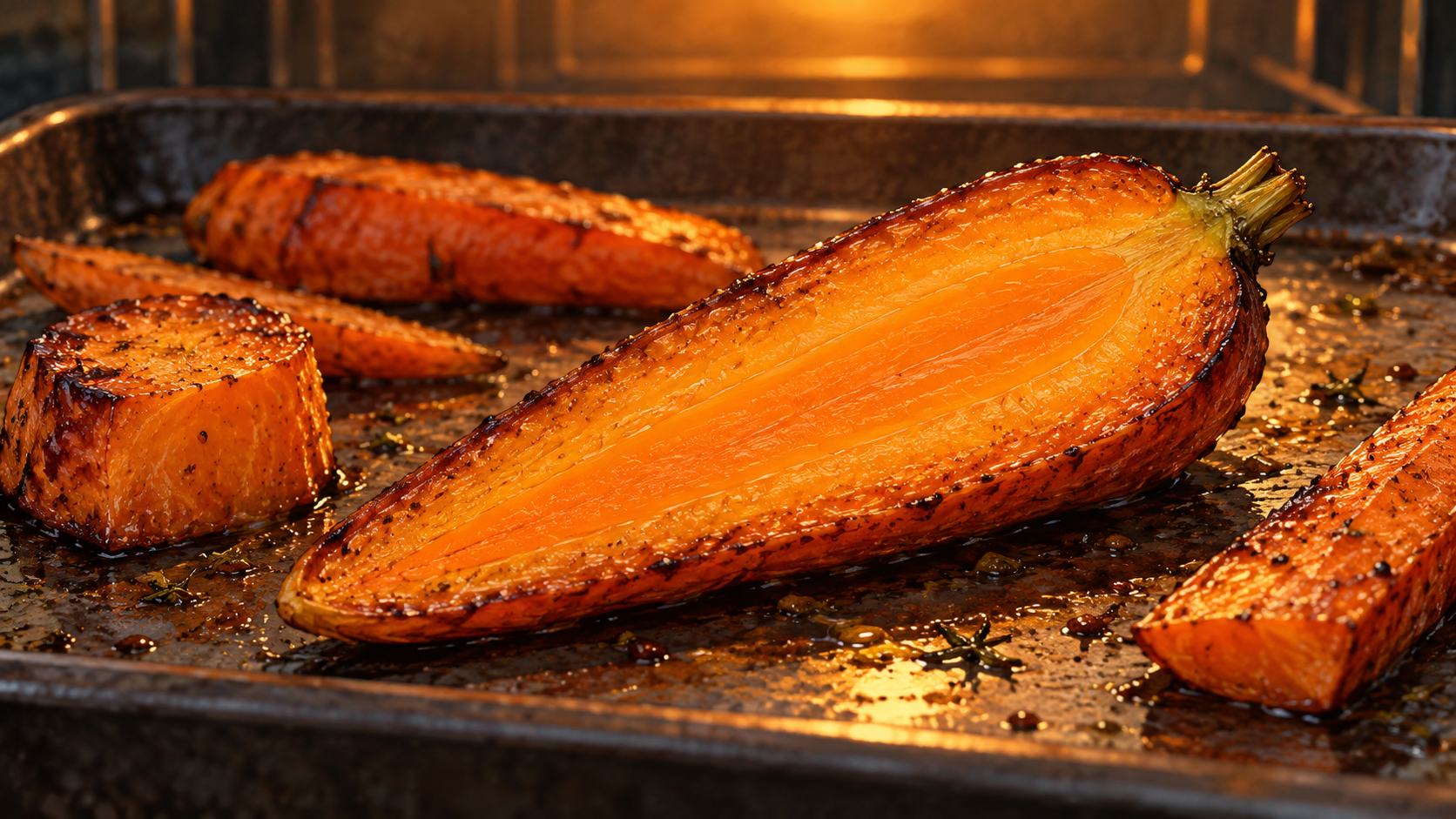
A roasting carrot can have a browned edge and a centre that still resists a fork. That is not a contradiction in the oven’s temperature setting. The dial describes the oven, while the carrot is an object with a surface and an interior, each living through a different part of the cook. Heat reaches the exposed outside first and works inward. At the same time, water leaves that outside, and the tissue within changes its hold on firmness. The result depends on how those processes meet, not on one temperature stamped across the whole root.
Imagine the thick end of a carrot cut crosswise just after it goes onto a tray. At first the whole cut face is close to its starting temperature. Warm air moves around it; the tray heats the part it touches; hot oven walls send radiation toward the exposed sides. None of these routes instantly warms the middle. Energy entering the outer tissue must pass through more carrot before it reaches the centre. This is a temperature gradient: temperature varies with position, and that variation changes as the carrot cooks. It is not a permanent hot shell around a permanently cold core.
Researchers have measured that lag in carrot pieces. Yoshiki Muramatsu and colleagues placed thermocouples at the centres of carrots cut into cylinders, a disk and a block, then warmed the pieces in a controlled 90°C water bath. They used the changing centre readings to estimate thermal diffusivity, a measure of how quickly a temperature change spreads through a material. Their estimated values for the carrot shapes were broadly similar even though the shapes differed. The work gives a way to think about heat travelling through carrot; a bath surrounding a piece with hot water is plainly not an oven surrounding it with air. Its ten-minute test cannot be converted into a roasting time. Muramatsu and colleagues’ original measurements
The thick end has farther to go
The important distance for a cook is not merely a carrot’s length. It is how far heat has to travel from an exposed surface to the place you want tender. A long, narrow stick can warm through differently from a short, thick chunk. Split a thick carrot lengthwise and the newly exposed plane brings the centre closer to the oven; cut a carrot into thin coins and there are two broad faces near almost every point within a coin. The exact speed changes with the size and shape, but the geometry has an obvious consequence: the thickest part is the last place to judge by eye alone.
This is why an evenly coloured tray can contain unevenly cooked pieces. A slender tip has much less interior to warm than the shoulder near the greens. If both are left whole, one end may be soft while the other still has a firm core. Making the pieces more similar in thickness is a practical way to bring their thermal histories closer together. It is a kitchen inference from heat penetration, not a claim that every piece must be identical or that one cut guarantees a precise finish time. In a separate retort experiment, Seung Su Yu and colleagues compared the heat penetration and quality of vegetables including carrot, and found that different vegetables had different heating characteristics and that texture tracked the thermal treatment. Their sealed, water-filled processing system is another reminder to respect geometry and material without borrowing its settings for dinner. Yu and colleagues’ original retort study
A useful mental picture is a moving front, but it is not a sharp boundary. The outer layers warm while the centre begins to rise more slowly. Eventually the gap narrows if heating continues. Along that path, the exposed face may cool itself by losing water, while the tray-contact face receives heat differently from the air-facing one. The carrot is never simply “at 200°C” because the oven is set there. Its surface temperature and centre temperature respond to heat coming in and water going out. Treating the oven number as a reading inside the vegetable would erase the very difference that determines whether the result is tender all the way through.
The surface has another job
The outside is changing in two ways at once. It warms, and it sheds moisture into the oven air. Water moving from the interior toward a drier surface can replace some of what is lost there, but it does not keep every layer equally wet. In a fluidized-bed experiment with cylindrical pieces of carrot, B. Honarvar and D. Mowla measured surface and centre temperatures while they dried the samples with hot air and, in some tests, added infrared radiation. Their hot-air-only measurements and model showed a cooler, wetter centre and an outward moisture movement. With added infrared radiation the calculated temperature pattern could change. That apparatus is a dryer, not a home oven; its value here is showing how heat, radiation and evaporation complicate a simple “outside hot, inside cold” picture. Honarvar and Mowla’s original carrot experiments
The surface’s loss of water matters to what the cook sees. A moist cut face and a dry, oil-coated face do not take colour in exactly the same way. A face pressed against a hot tray has a different exposure from one facing open oven air. In an oven study, Şeyda Öztürk and Esma Nur Geçer cut carrots into cubes, left some uncoated, coated others with different edible films, and baked them under the same stated oven condition. The coating treatments produced measurable differences in colour, browning index and texture; the agar-coated sample had a lower browning index than the uncoated control. That experiment does not tell us which coating to put on a household roast carrot. It does show that the condition of the surface changes the visible result even when the oven setting and duration are held to a study protocol. Öztürk and Geçer’s original baking study
Colour, then, is a report from the outside. It may be exactly the colour you want, but it is a poor witness to the state of the thickest centre. An edge can dry and brown while the inside has yet to receive enough heat to soften. Conversely, a small piece can be thoroughly tender before it has spent much time with a dry, coloured face. Roasting asks the cook to coordinate these two changes. More time is not always the only useful adjustment: a different cut changes the distance to the centre, while a less crowded tray changes how exposed surfaces meet moving air. Those are consequences of heat and moisture transfer, not a promise that any arrangement will give the same result in every oven.
Tenderness is more than warmth
Even a centre that has warmed well is not tender simply because it has reached an arbitrary number. The firmness of raw carrot comes partly from water pressure inside intact cells and partly from the walls and connections among them. Heating changes those structures over time. In experiments on carrot discs, Annie Ng and Keith Waldron found that cooking at 100°C softened the tissue, with cell separation and changes in pectic material in the walls. A gentler pre-cooking step altered cell adhesion and reduced subsequent softening. Their discs were cooked in water, not roasted, yet the tissue they examined is the same kind of tissue that gives a roasted carrot its bite. Their result helps explain why heat history matters as well as the latest centre temperature. Ng and Waldron’s original carrot-tissue study
There is room between crisp and collapsing. A cook might want a carrot that holds a clean shape yet gives easily at the centre, or one soft enough to mash against a fork. Those are different endpoints for the same root. A narrow tip and a thick shoulder can reach either endpoint at different moments, while the outer layer may already be drying. The measurements above explain why a single rule based on oven time, oven dial or surface colour cannot settle every carrot. Variety, starting temperature, cut, tray, spacing and oven behaviour all change the path; the studies cited here did not test every combination.
The most direct check is small and local: put a fork or thin knife into the thickest piece, then look at the surface you plan to serve. If the outside is darkening faster than the centre softens, a thinner cut next time addresses the long route inward. If the pieces are tender but pale, giving their surfaces more room and exposure addresses a different part of the process. Neither observation requires pretending that the middle and the rim have shared one temperature throughout the roast.
What makes a good roasted carrot is the brief overlap of two clocks. One runs inward as warmth reaches and alters the tissue; the other runs outward as the surface loses moisture and develops colour. The oven starts both. The shape of the carrot and the way it sits on the tray decide whether they finish together.
A thought worth keeping?