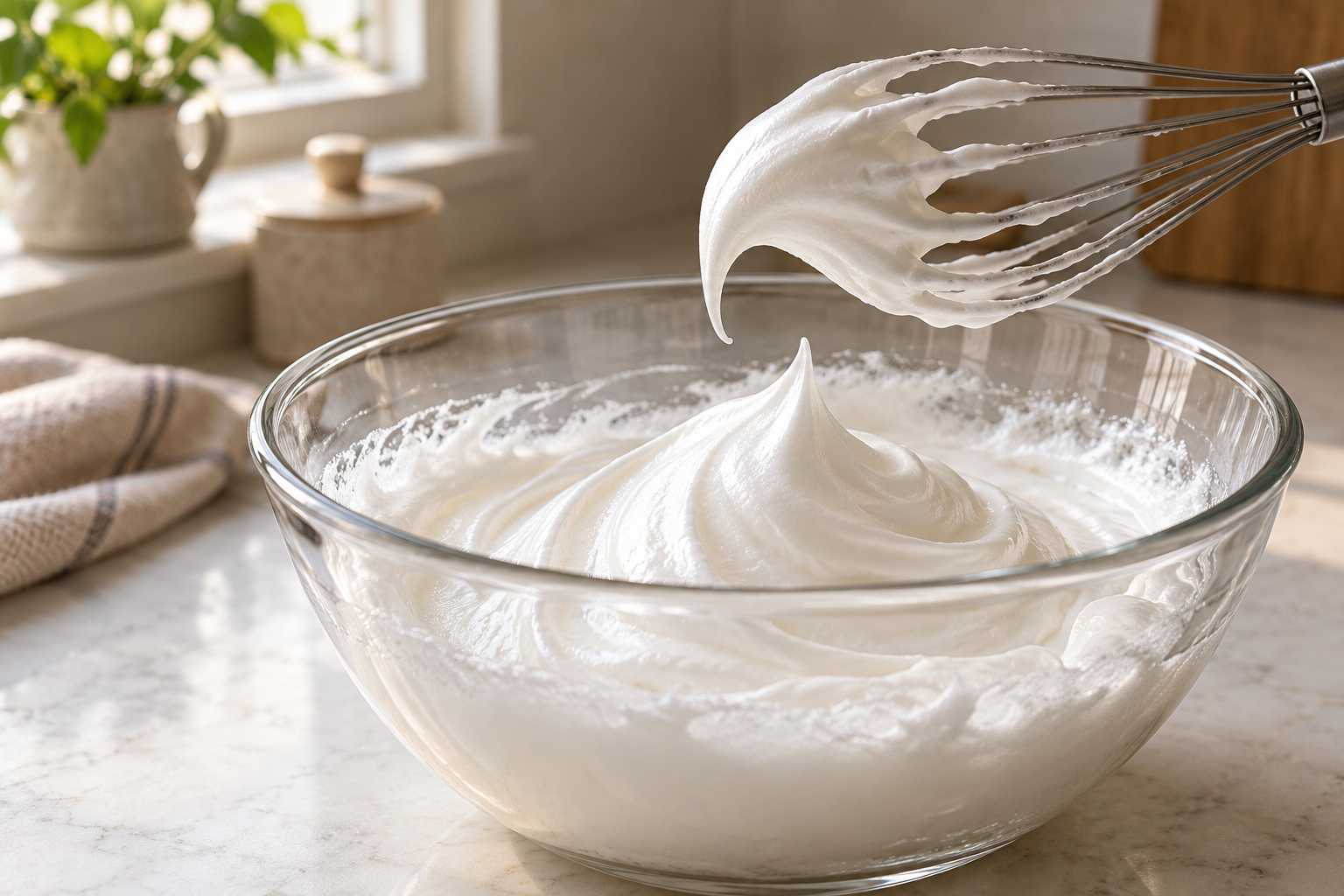
A spoonful of meringue looks almost solid when it holds a peak, yet much of its volume is air. The air is not suspended by sweetness alone. Each bubble sits inside a thin, wet boundary made from egg-white proteins and liquid; thousands of those boundaries must survive long enough for the cook to shape the foam and, in a baked meringue, for heat to set it. The interesting question is not simply how to beat more air in. It is how the air stays there.
Egg white starts as a liquid in which proteins are folded and dispersed. Whisking drives air through it, breaking large pockets into smaller bubbles and exposing new air–water surfaces. Some proteins gather at those surfaces and change shape. In an original study of ovalbumin at an air–water boundary, researchers used spectroscopy to show that the adsorbed protein was partly unfolded compared with ovalbumin in solution. Compression of the surface layer encouraged protein interactions and a network at the interface. Ovalbumin is one component of egg white, and this was a molecular interface experiment, not a mixing bowl. It nevertheless shows why the bubble wall is an active structure rather than a film of plain water.
Making a bubble is easier than keeping it
Freshly whipped foam can grow tall while its liquid begins to move downward. Thin films between adjacent bubbles lose water; bubbles can merge when a film breaks. Small bubbles can also lose gas to larger ones. What appears from above as one glossy mass is therefore an arrangement under constant pressure to rearrange. Food scientists distinguish foaming capacity—how much air can be incorporated—from stability—how long the resulting structure resists drainage and collapse. A high first volume is not necessarily the best final meringue.
That distinction appeared clearly when Helena Bovšková and Kamila Míková whipped fresh and pasteurised whites under controlled conditions and measured foam volume, density and liquid drainage. Adding sucrose reduced the volume they could whip in, yet made the foam more durable in their tests. Sugar is therefore doing more than sweetening. By changing the liquid between bubbles, it can make the foam slower to drain even while it makes air harder to incorporate. The exact balance depends on the whites, the sugar amount and the way the mixture is beaten; the experiment supplies no single instruction to use a fixed spoonful in every kitchen.
A 2022 microscopy study made meringue-like egg-white foams with different sugar and acid conditions, then measured the bubbles and the liquid films between them. In that set of foams, sugar thickened the liquid and shifted the bubble-size distribution toward smaller bubbles. Acid changed bubble shape and the way the foam responded to gentle deformation. A peak that holds is thus not just “more protein.” It is a particular distribution of air, water and fragile walls, shaped by the ingredients and by the work of the whisk.
The small changes that tilt the balance
Fat makes the first step less dependable. In experiments on liquid egg white, G. Wang and T. Wang added measured amounts of yolk, varied shearing and applied heat. Even a small yolk contamination reduced the speed and capacity of foaming; the neutral-lipid part of the yolk accounted for much of the effect under their conditions. This supports the familiar insistence on a clean bowl and well-separated whites, but it is more precise than saying a single invisible speck will always ruin a batch. The study also found that short, fast shearing did not necessarily damage the whites, while prolonged shearing could impair their foaming performance. The problem is an interaction between material and treatment, not a stopwatch that applies to every whisk.
Acid can shift the balance too, but “more acid means better foam” is a poor rule. Bovšková and Míková found good volume and low drainage in both an acidic range and a near-neutral range, depending in part on whether the white had been pasteurised. They also noted that earlier studies had found different pH optima. In the 2022 bubble-imaging work, acidity changed the shape and mechanical response of the bubbles in the tested mixtures. These are useful observations about how acid can alter proteins and films; they do not justify pouring acid into a meringue until it becomes more stable by definition.
There is another reason to separate a wet foam from a finished dessert. In a 1989 study of meringue puffing, Kiyoe Ito and colleagues varied sucrose and organic acids. Increasing sugar made the unbaked meringue denser, yet their baked meringues expanded differently, with the best puffing at the saturated sugar amount in that particular formulation. Cream of tartar, citric acid and acetic acid each helped the wet foam, but only cream of tartar improved puffing in the baked test. A bowl that looks loftiest before heating need not produce the most open baked structure. This does not make one acid universally superior; it shows that the measurement changes when the foam enters the oven.
Heat gives the air a lasting address
Before baking, a meringue is a wet, deformable network. Heat changes the proteins and drives water away, turning the arrangement of bubbles into a firmer structure. In a 2025 experiment under a temperature gradient, Manami Tai and Shuji Fujii watched egg-white foams move from a wetter pattern of rounded bubbles toward a drier pattern with many-sided bubbles as gelation progressed. The films between bubbles thinned as the material changed. Those observations were made in a controlled setup; they are not a minute-by-minute map for every oven. They do show that baking does not merely preserve a frozen snapshot of what the whisk made. The walls, the liquid and the spaces all continue to change.
That is why texture depends on the route from bowl to finished piece. A soft topping and a crisp, dry meringue begin with the same kind of aerated white, but heat exposure and water removal give them different structures. A 2012 X-ray microtomography study of baked meringues measured their pores and compression response after varying sugar, citric acid and the form of egg white. Lower sugar-to-white ratios and more citric acid produced more air and softer meringues in those recipes, while fresh, pasteurised, powdered, frozen and older whites did not behave identically. The result is a reminder that a finished bite records both the original foam and what processing did to it.
The peak on the whisk is a useful sight, but it is not a guarantee. It tells us the mixture has caught air and, for now, its network can bear its own weight. The hidden test is whether the films can keep their water and remain connected through shaping and heat. A meringue's lightness comes from air; its craft lies in giving that air walls strong enough to last.
A thought worth keeping?