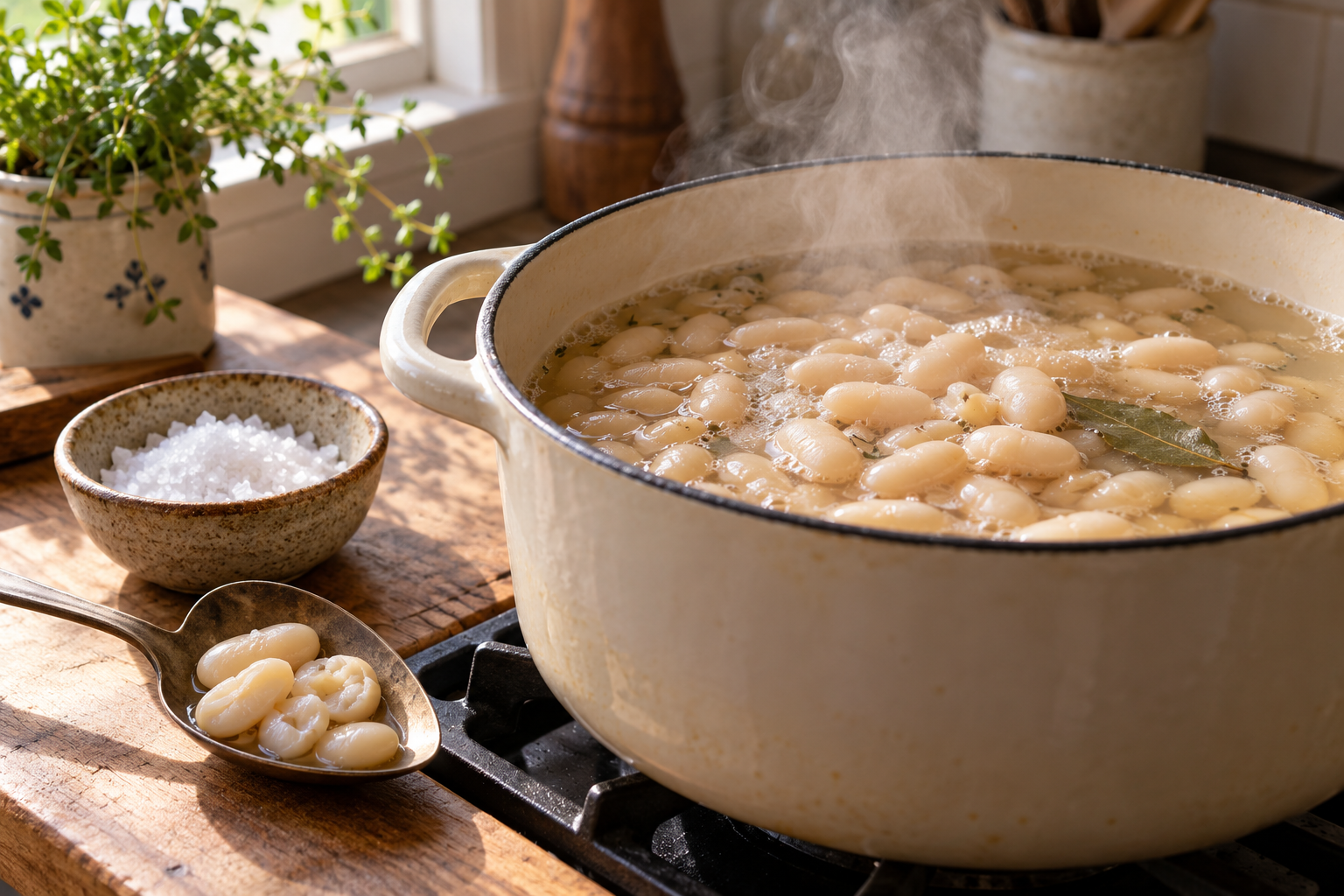
Lift a bean from a simmering pot and press it between your fingers. The skin may resist while the centre yields, or both may still feel firm. A pinch of salt will improve the flavour of the finished bowl, but its effect on that bean's texture is less obedient to the familiar instruction to add it only at the end. The answer changes with the bean, the water and the amount of salt, as well as with whether the salt went into a soak or the cooking pot.
That makes the question more interesting than a kitchen rule. Dried beans must take up water; heat then changes the seed's starch, proteins and the material binding its cells together. A treatment that alters water uptake or cell separation may alter the time it takes a bean to become creamy. Salt is one possible treatment. It is not the only thing in the saucepan, and the name “salt” covers compounds with different effects.
What has to soften
A bean is not a uniform pellet. Its outer coat and inner cotyledons can behave differently. In an original study of nine common-bean varieties, Peter Kinyanjui and colleagues measured water uptake and tested cooked texture both by finger pressure and by a cutting instrument. Some varieties reached tenderness much sooner than others. The investigators found that dehulling, soaking conditions and the bean's starting hardness all mattered. A pot with stubborn beans may be telling you about the beans' history before the water ever boiled.
The same study helps explain why the chemistry of the water matters. The researchers soaked one easier-cooking and one harder-cooking variety in solutions of different acidity and mineral content, then compared their softening. Acidic solutions slowed it; alkaline solutions sped it. Calcium chloride kept both varieties firmer. The authors linked calcium's effect to pectin, part of the material that helps adjacent bean cells hold together. Calcium can form bridges in that material, making the cells harder to separate during cooking. Their sodium chloride treatment, however, did not measurably change the cooking rate of either tested variety.
That result is a useful brake on loose explanations. Baking soda is sodium bicarbonate, an alkaline compound; table salt is sodium chloride. The study's strong softening with bicarbonate or sodium carbonate cannot simply be transferred to a spoonful of table salt. Nor can the firming effect of calcium chloride be assigned to sodium chloride because both names contain “chloride.” The relevant ion, concentration and acidity differ. The researchers themselves described bean hardening as a complex process rather than one reaction with one guaranteed remedy.
Why another trial found a shorter cook
In a 2017 Red River College cooking study, Joel Lamoureux's team tested navy, black, pinto, kidney and faba beans. They compared unsalted cooking with several measured salt concentrations and a separate salt-brine soak. Their tests included an instrument that timed how long weighted plungers took to pierce most beans, a kitchen-style doneness assessment and a small consumer ranking exercise. This was more than a cook's impression from one saucepan, though it was still a defined set of beans and conditions.
In that study, a 2 percent salt soak and 1 percent salt in the cooking water cut average cooking time by roughly 12–14 percent relative to the team's controls. The salted beans also ranked better for texture and flavour in the tasting they reported. At the high end, 3 percent salt made skins firmer and interiors gritty and overly salty. The finding does not say that more salt always makes a bean soften faster. It gives a bounded range in one experiment: moderate treatment helped there, heavy treatment hurt.
The Red River tests soaked beans for 24 hours and used specified water and cooking temperatures. Kinyanjui's experiments used other varieties, solutions and timings. Those differences are large enough that the results should be placed beside one another, not averaged into a universal minute-saving promise. A fresh navy bean in a controlled trial and an old pinto bean from a warm cupboard need not respond alike. Even the meaning of “done” changes if one method counts a punctured skin and another values an intact bean with a creamy centre.
The Red River researchers' own later account turns their work into cooking guidance, distinguishing a brine soak from salt added to the cooking water. That is a sensible distinction to preserve. Salt in the soak has hours to act before the pot is heated; salt introduced during simmering encounters a bean already taking up water and changing structure. A result for one stage cannot automatically settle the other.
The bean came with a history
Age is not simply a number of months on a package. In an experiment with mature red kidney beans, Wilfredo Moscoso and colleagues stored them under high temperature and humidity for nine months. As storage continued, they softened more slowly during cooking, and the rate at which pectin dissolved also fell. A separate black-bean study found a hard-to-cook defect developing under warm, humid storage and argued that reduced water absorption alone could not explain the large difference in cooked hardness. The two studies do not assign every tough bean to one cause. They show why salt cannot be judged while storage history is ignored.
Water is another hidden ingredient. The Red River study tested water hardness as well as salt and reported changes in cooking time and seed-coat texture. Kinyanjui's calcium treatment gives a more specific reason to watch mineral content. The exact result in a household pot depends on the water actually used; it is too easy to blame a late pinch of salt for a bean that also met hard water, acid and months of hot storage. Colorado State University Extension advises that salt may go in the soaking water and permits it in the cooking pot. University of Maine Cooperative Extension recommends adding it near the end. Their differing advice is a sign that a cook should look closely at the conditions, not a reason to pretend there is no evidence.
For an ordinary dinner, begin with sound beans stored cool and dry, give them enough water, and simmer until they actually feel tender. If a recipe includes tomato or vinegar, the bean experiment's low-pH result and Maine's guidance both support waiting until the beans have softened before adding those acidic ingredients. Seasoning can then be adjusted for taste. If you want to learn what salt does in your kitchen, split one bag of the same beans between two pots, use the same water and heat, measure a modest difference in salt, and check several beans from each pot at intervals. A single pair of pots will not prove a general law, but it can tell you more than a slogan about the beans you are eating.
The useful result may be a bean that tastes seasoned through and through, or one whose skin stays whole while its centre turns creamy. Salt can contribute to those outcomes, yet its amount and timing share the work with water, heat, variety and storage. When the spoon comes up, judge the bean in it before judging the rule that told you when to salt the pot.
A thought worth keeping?