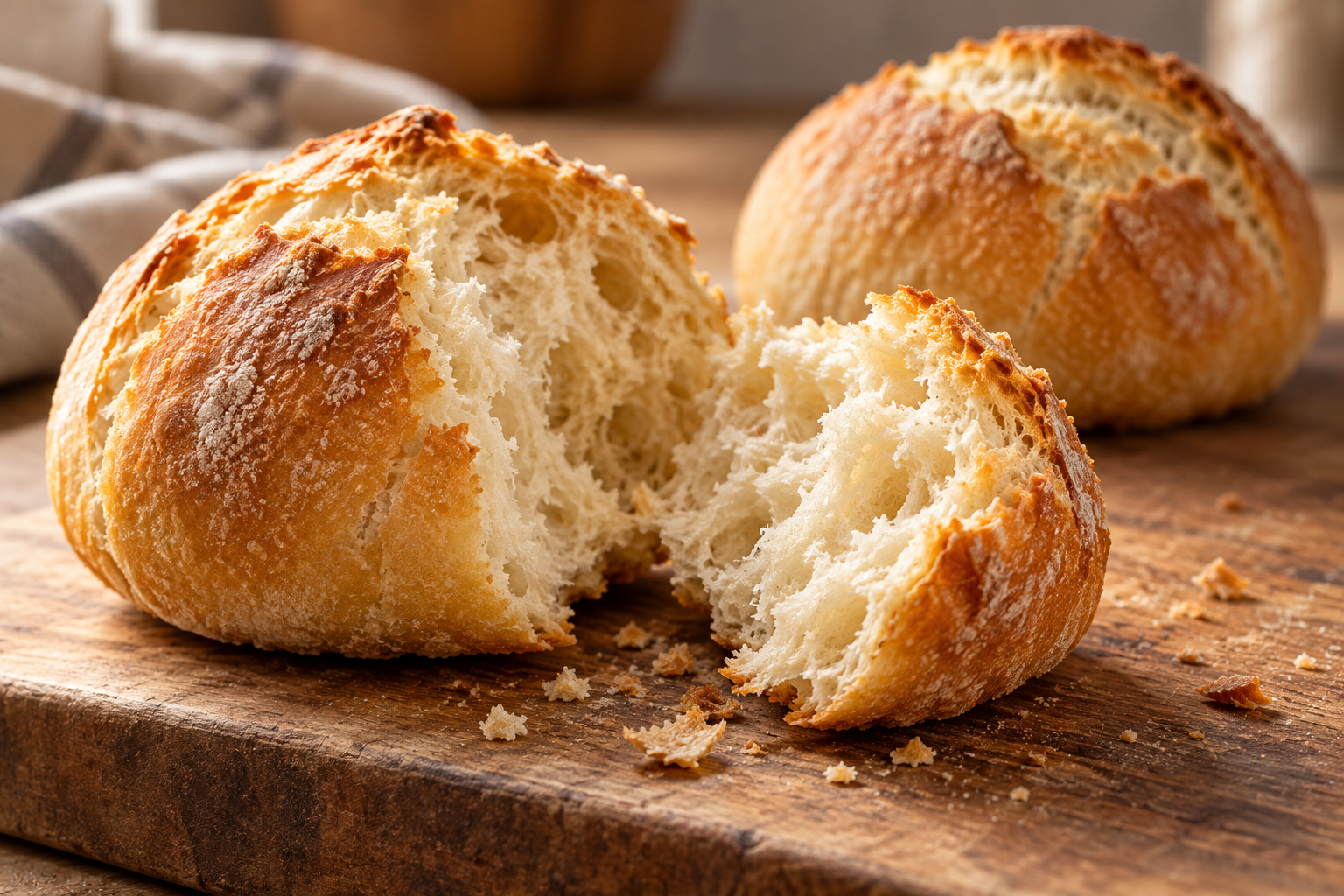
A crusty roll can lose its crackle while sitting in a dry room. Nothing has splashed it. The water is already inside: the soft crumb holds far more of it than the crust that the oven left dry and brittle. After baking, some moisture moves toward that crust. The contrast that made the first bite pleasant also starts a quiet exchange that changes the next one. In a 2010 bread experiment, researchers measured water accumulating in the crust from the wet crumb as their rolls lost crispness. The loaf was working against one of its own textures.
This is why crispness is more than a matter of how brown the surface looks. A dry crust fractures in many small, sudden breaks that send sound through the air and force through the teeth. As it takes up water, it can become tougher and less prone to those sharp breaks. Researchers built a simplified baked crust to separate that effect from the softness of the crumb and the curvature of a whole roll. At a water activity of 0.65 in their model, the force needed to break it rose while the number of sound and force events fell. That figure is a result for the model, not a universal point at which every bread stops sounding crisp. It connects the felt loss of crackle to a measurable change in fracture.
Water can reach a crust from the room as well as from the crumb. In tests of crust water uptake, the rate varied with the surrounding relative humidity. It also depended strongly on how the experiment changed that humidity: rates derived from one oscillating test were about ten times those derived from a stepwise test. The difference cautions against attaching a single stopwatch to the phenomenon. A roll cooling in one room, then stored in another or enclosed with its own crumb, does not have one fixed lifetime of crispness.
A porous crust can keep its crackle longer
At first, a tight crust might seem like the best guard against moisture. It could keep humid air out. But it can also hold the crumb's moisture at the very surface one wants to keep dry. In the 2010 study, researchers made small channels through an experimental crust. Doubling its water-vapour permeability cut crust water uptake roughly in half. After four hours, the modified rolls were as crisp by the study's measures as the control rolls after 30 minutes. The intervention let more vapour escape instead of trapping it where it could soften the crust. This was an experimental change to particular rolls, not an instruction to puncture a finished loaf at home.
The crumb changes the route water takes to get there. Bread is a network of air cells, and the openings between them matter more than a glance at the size of a few holes. In a 2012 comparison that varied crumb and crust properties, less-connected air cells slowed effective vapour movement through the crumb and helped rolls with similar crusts stay crisp longer. Yet changing the crust had the larger effect in those experiments. The finding is not a rule that coarse bread is crisp or fine bread is soft. It says that the path between wet interior and dry shell has a structure, and both ends of that path count.
Bakers create that structure before the loaf enters the oven. A study of rolls proofed to three different volumes used X-ray microtomography to inspect their interiors. The shorter-proofed test rolls took up water into the crust more slowly during cooling and scored higher for crispness after storage at low relative humidity. The authors proposed a finer, less-connected crumb and a thicker crust as part of the reason. Proofing changes several features at once, so this is not a general case for stopping every home dough early. It is evidence that a crust's later behavior begins with the loaf's construction.
Opening the crust to vapour creates a second problem: the crumb could dry out. In a later permeability study, researchers tried different numbers and sizes of channels and evaluated both crispness and softness. Under their 40-percent-relative-humidity storage conditions, selected channel arrangements extended sensory crispness by as much as eightfold without reducing crumb softness. The useful result is the need for a balance, not the eightfold figure as a promise for ordinary bread. A loaf is judged on two textures at once, and an intervention that protects one can sacrifice the other if pushed too far.
Nor should every change in an older loaf be blamed on this one water journey. In a sealed-pouch study of white bread, crumb stored with its crust lost moisture and water activity over two weeks; crumb stored without crust did not show the same loss. The crust's presence mattered especially for the greater firming seen after seven days. But the researchers said the cause of the initial firming in the first week was inconclusive. Bread staling involves changes within the crumb too. Moisture moving into the crust explains a loss of crackle; it does not, by itself, explain every change in crumb softness.
A bread roll therefore begins with a short-lived bargain. Baking gives its outside a low-water, breakable shell and leaves its inside comparatively moist and yielding. Cooling and storage give water routes across that boundary, shaped by air-cell connections, crust permeability and the room around the loaf. The first audible fracture is real, and so is its fading. To understand why, look toward the moist centre as well as the air outside.
A thought worth keeping?