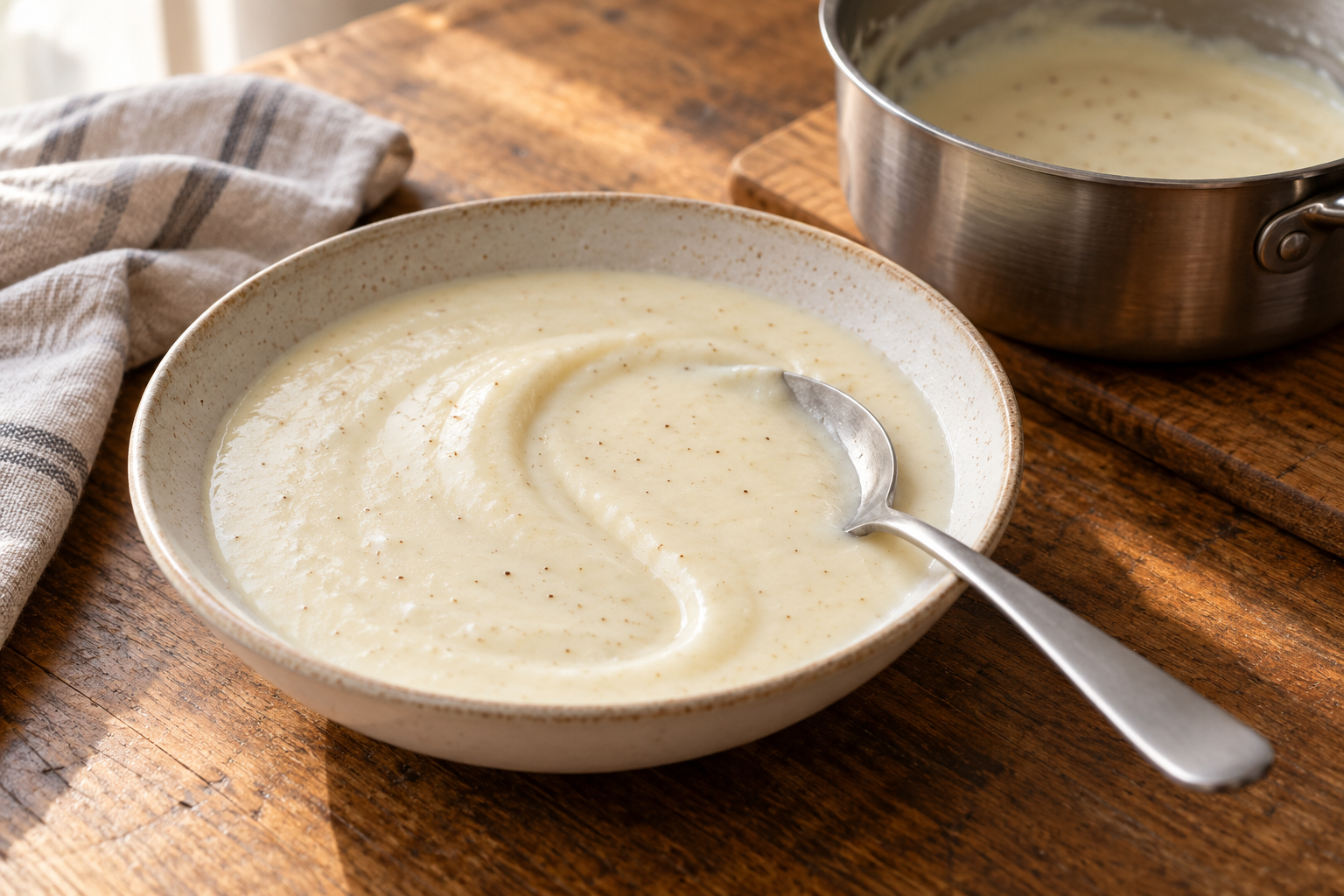
A spoon pulled through hot white sauce may leave a track that closes almost at once. Let the sauce cool in a bowl, and the next track can linger. The ingredients have not multiplied. The sauce has changed temperature, and the starch that thickened it in the pan has more work to do. In a 1979 study that followed white sauce from cooking into cooling, researchers measured a marked rise in both rigidity and the force needed to start flow as samples cooled from 60°C to 20°C. That is a more precise description of the spoon's mark than simply calling the sauce “thicker.”
The explanation applies to sauces thickened with starch, such as a flour-based white sauce or one made with corn or rice starch. An egg-thickened custard, a butter emulsion, and a reduced tomato sauce have different structures. Even among starch sauces, the result depends on the starch, the liquid, the other ingredients, and how the mixture is cooked and stirred. The cooling pan is a useful place to begin, but it is not the whole story.
What the heat has already done
Starch begins as tightly packed granules. Given enough water and heat, those granules swell; some starch molecules move into the liquid around them. The mixture grows resistant to flow because swollen granules take up space and the released molecules contribute to a continuous phase. A 2010 comparison of five starches used in white sauces makes the process less tidy than the instruction “cook until thick.” In water at 90°C, longer cooking produced more swelling and more released starch, but the effect varied by starch. Potato starch granules were completely disrupted after 300 seconds under the study's conditions. The accompanying structural change could reduce the mixture's viscoelasticity. More cooking, then, does not guarantee a sauce that will hold more firmly once it cools.
As a cooked starch mixture cools, its swollen granule remnants and released chains can interact more strongly. Some chains associate into a network that resists movement. In a controlled study of rice and tapioca starches, researchers measured a rise from the hot paste's trough viscosity to its final viscosity during cooling. They call that rise setback. Normal starches, which contained amylose, showed a much larger setback than their waxy counterparts in the tested systems. The same study linked final texture to chain entanglement, reassociation, and the amount of swollen granule material left behind. Cooling is thus more than a pause after thickening: it changes how the cooked starch holds together.
The word gel can make this sound as though every sauce sets like a dessert. It need not. The network may be weak enough to yield readily under a spoon. A 2021 experiment with rice-starch white sauces found weak-gel behavior alongside shear thinning: the sauces offered less resistance as they were sheared more strongly. The older white-sauce study also found shear-thinning flow. This is why a sauce can mound gently at rest yet pour more easily after stirring. A comparison between a hot pan that has just been whisked and a cool, undisturbed bowl confounds two changes, temperature and motion.
The recipe changes the result
The starch itself is only one ingredient. In the five-starch white-sauce study, adding sauce ingredients altered what longer cooking did to granules compared with starch cooked in water alone. A separate sugar-and-acid experiment found that the tested starches began pasting roughly 10–12°C higher in that mixture than in water. Their final viscosities did not all respond alike. Those are controlled test mixtures, not instructions to add sugar to dinner sauce. They show why a temperature or texture rule measured in plain starch and water cannot simply be copied into a recipe with other ingredients.
Soy sauce offers a more savory example. In a 1997 corn-starch experiment, researchers added different commercial soy sauces to a starch-and-water mixture and ran heating and cooling cycles. Both the peak viscosity during heating and the viscosity after cooling to 50°C differed among samples. Sodium content and acidity explained part of the difference. “Soy sauce” was not one interchangeable variable; different bottles changed the starch's behavior differently. A cook may notice a sauce loosening or tightening after an ingredient is added, but the direction cannot be inferred from that ingredient's name alone.
Cooling to serving temperature and keeping a sauce cold for days are also different clocks. A 2025 study of concentrated corn-starch gels held in refrigeration tracked molecular reassociation over 25 days. The measurements fitted two phases, divided at about day five in that system. Breaking behavior changed, and the proportion of water separated from the gel rose during storage. This does not set a five-day timetable for a leftover white sauce. It demonstrates that starch structure can keep changing after the first cooling, and that a firmer gel may also fail to hold all its water.
An additional transition can make separation more conspicuous. The rice-starch white-sauce study saw no water separation in its freshly prepared sauces, but did see it after a freeze–thaw cycle; treatment of the starch altered how much water came out. A watery rim around a thawed sauce is therefore a different observation from a hot sauce becoming pleasantly thicker on the plate. Both involve starch and water, but the storage history matters.
There is even a useful exception to the pan-first sequence. Researchers making model sauces with extruded wheat and rice flours obtained sauce-like flow without heating the mixture at preparation. Extrusion had already gelatinized the starch in the flour. The sauce could thicken cold because the heat-dependent step happened earlier, before the flour reached the bowl. Its behavior still varied with grain and particle size.
For a starch-thickened sauce, the honest test is at the temperature and degree of stirring at which it will be eaten. A loose-looking hot spoonful may settle into the intended texture; a cold stored sauce may become firmer or shed water for reasons beyond that first cooling. The pot shows the beginning of the texture, not its final form.
A thought worth keeping?